Advertisement
Why do so many Reading cases get opened again on the airport floor?
It is almost never too much stuff. It is a bag packed loose in a Reading flat the night before the Heathrow train.
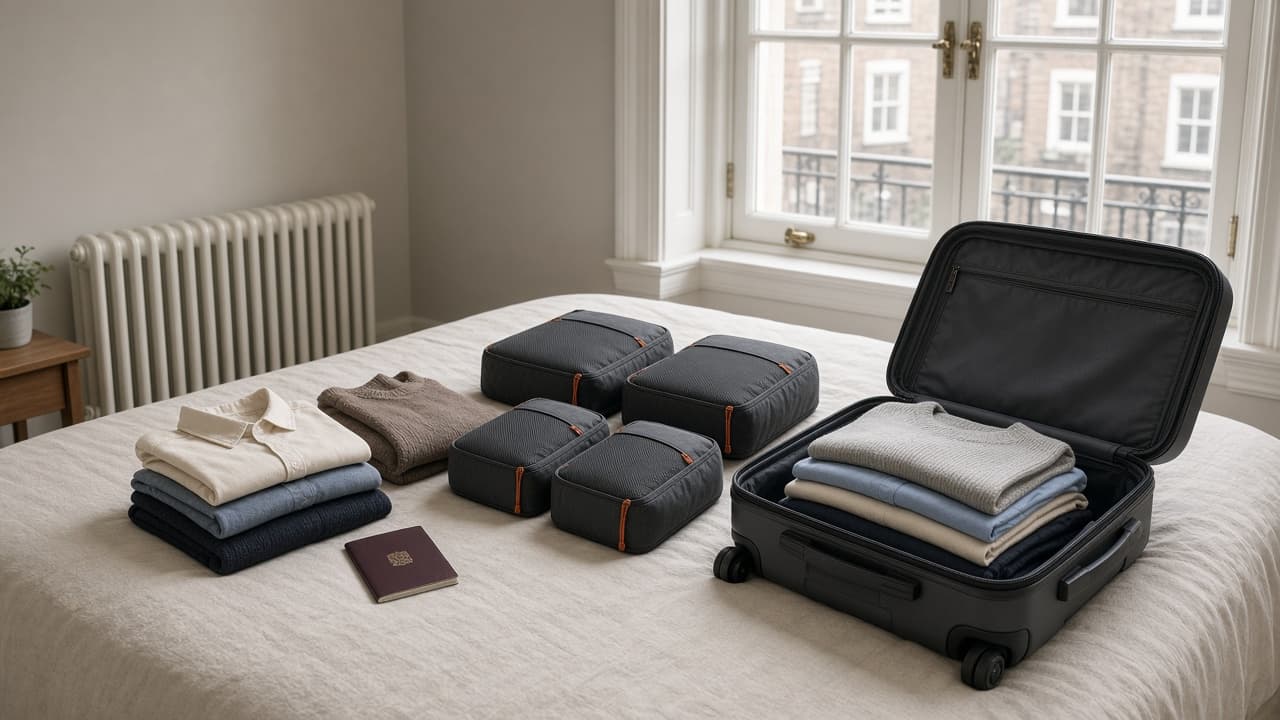
A trip out of Reading is rarely a light one. You go away for five days and you pack for three kinds of weather, because the forecast on the Thames Valley changes twice on the way to the station. There is a waterproof in the case that may never come out. There is a jumper for the evening even in July. If it is half-term there are two children's piles as well, and they are going in the same case as yours because a second bag costs more than the taxi to Heathrow.
Then there is the cabin bag, which is the same size every single time. The airline gives you a box of fixed dimensions and the case gives you a shell with wheels and a handle bar eating into the base. That is all the room there will ever be, and no amount of sitting on the lid changes it.
The problem is air, not clothes
Watch someone repacking at a check-in desk. They are not throwing things away. They are flattening. What comes out of that case is not jumpers, it is the air between them — the gaps left by a pile that was built loose at eleven at night the day before.
Loose packing costs twice. First it takes room you needed. Then it shifts: the neat stack becomes a landslide somewhere between the bus and the baggage belt, and the thing you laid flat on top arrives creased under everything else. By day three the case holds three different populations — clothes you have not worn, clothes you have, and shoes that have been on a pavement — and they are all mixed together, which is how a clean shirt ends up smelling like the trip.
What changes when the packing is held
A compression cube is a soft box with two zips. The first closes it like any packing cube. The second runs lower around the body, and pulling it round folds the walls inward so the stack inside loses the air between its layers. Nothing is vacuum sealed and nothing needs a pump, which is why it works just as well in a hotel room at midnight as it does on the bed at home.
The gain is not really capacity, although the room for a second pair of shoes is usually there. The gain is that the case stays packed the way you left it. Blocks do not slide. Shirts that would crease in a cube go flat in a garment folder instead, folded once over a board so the crease lands on the same line every time. Worn clothes go in a drawstring sack with a mesh top so they can breathe, and shoes go in their own zipped bag, soles together, away from everything else.
Unpacking then takes two lifts rather than an hour. And on the way home, the case closes again, because the dirty half was never allowed to expand into the clean half.
The bag first, the price after
The mistake people make buying this kit is buying a size. Four medium cubes arrive, two of them fit the case, and the other two live in a drawer. A cube is the right product in the wrong dimension more often than it is a bad cube.
So we do it the other way round. Tell us the bag you actually fly with, how long you go for and how many people pack out of it, and we come back with the size mix that fills that case — then the written quote for it. No basket, no card details, nothing charged on this page. If the set we suggest is not what you had in mind, say so and we will quote a different one.
Ask about your own bag
Ask which set fits your bag
Describe the case and the trip. We reply with the sizes we would put in the set and a written price. It is a request, not an order.
More detail on each item is on the packing range pages, and the steps from request to quote are set out on the ask for a quote page.